
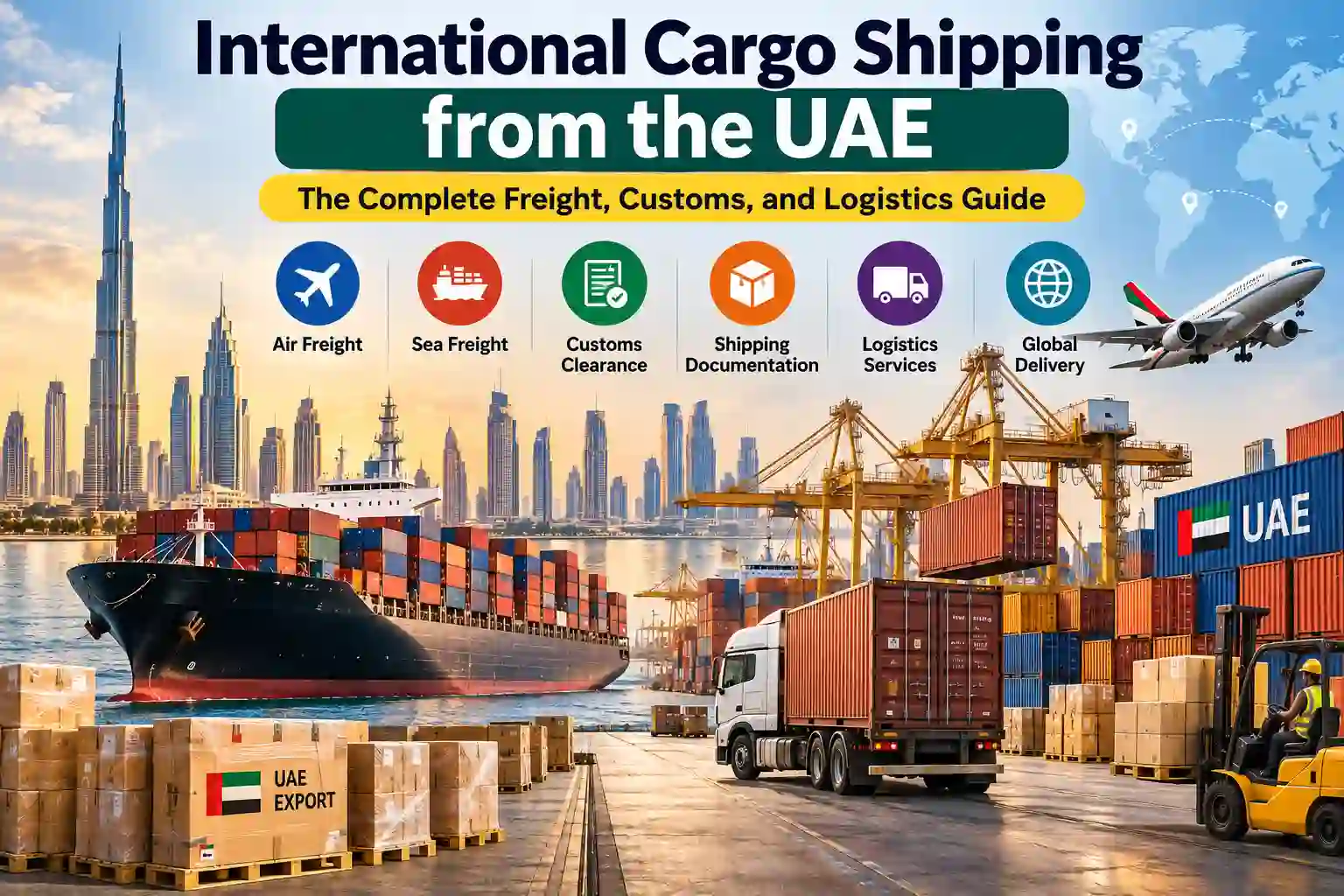
As one of the world’s preeminent global trade crossroads, the United Arab Emirates connects East and West through some of the busiest marine ports and air freight hubs on the planet. From Jebel Ali Port and Khalifa Port to Dubai International (DXB) and Al Maktoum International (DWC), millions of tons of cargo move outbound from the Emirates every year.
However, international cargo shipping involves far more than simply boxing items and booking carrier space. Whether you are an expat sending excess baggage and personal effects back home, an e-commerce business exporting goods to global markets, or a corporation shipping commercial machinery, managing an overseas consignment demands a clear understanding of freight modes, international commercial terms, customs documentation, and carrier accountability.
Below is an operational breakdown of international cargo shipping from the UAE, covering freight methods, pricing mechanics, documentation standards, and how tech-driven platforms protect your shipments.
1. Cargo Freight Modalities: Choosing the Right Transport Channel
Selecting the right shipping method depends on your shipment’s gross weight, total volume (cubic meters), urgency, and destination infrastructure.
- Air Cargo: Express vs. Standard Freight
- Express Air Cargo: Best suited for time-critical commercial shipments, valuable electronics, urgent legal documentation, and essential personal effects. Consignments fly on scheduled commercial flights or dedicated freighter aircraft from Dubai or Abu Dhabi, typically reaching major global hubs within 24 to 72 hours.
- Standard General Air Cargo: Designed for shipments exceeding 45 to 100 kilograms where cost efficiency takes priority over immediate same-day dispatch. Transit times typically average 3 to 6 business days door-to-door.
- Volumetric Weight Calculation: Air freight charges are calculated using the greater of actual gross weight or volumetric (dimensional) weight, calculated globally as:
If your shipment consists of lightweight but bulky boxes, the airline will bill according to the dimensional space the cargo occupies in the aircraft hold.
- Ocean Sea Freight: Dedicated vs. Consolidated Consignments
- Full Container Load (FCL): You secure exclusive use of a 20-foot container (holding approximately 30 to 33 cubic meters) or a 40-foot container (holding approximately 65 to 70 cubic meters). The container is loaded, sealed at your premises or warehouse, and moved directly to the port terminal. FCL delivers the lowest risk of physical handling and the fastest port-to-port ocean transit.
- Less-than-Container Load (LCL / Consolidated Cargo): If you are shipping between 1 and 15 cubic meters, your goods share container volume with other cargo heading to the same destination port. LCL is significantly more economical for smaller commercial orders and personal consignments, though it requires additional time for warehouse consolidation at the origin port and deconsolidation at the arrival port.
- Cross-Border Land Cargo (GCC Network)
- For freight moving to neighboring Gulf nations—including Saudi Arabia, Qatar, Oman, Kuwait, and Bahrain—overland road freight via dedicated 3-ton to 10-ton box trucks or 40-foot articulated trailers provides an efficient door-to-door alternative to sea freight, often arriving within 2 to 5 business days.
2. Understanding Port Costs & Quotation Structures
One of the most common pitfalls in international cargo shipping is accepting an artificially low estimate that excludes destination fees. When comparing cargo rates, you must understand the pricing breakdown:

Door-to-Door vs. Door-to-Port vs. Port-to-Port
- Port-to-Port: The freight forwarder only covers transport from the UAE marine terminal to the destination port terminal. The receiver is fully responsible for customs clearance, port authority fees, and final-mile transport.
- Door-to-Port: The forwarder collects the shipment from your UAE home or warehouse and delivers it to the destination arrival port. The receiver handles customs clearance and local delivery.
- Door-to-Door: The comprehensive standard. The carrier manages pickup, export customs, international freight, destination customs clearance, payment of pre-agreed terminal fees, and direct delivery to your residential or commercial address.
Terminal Handling Charges Explained
Terminal handling charges represent the official fees levied by marine port and airport terminal operators for loading, offloading, equipment handling, and moving cargo through the terminal facility.
- In a professional door-to-door contract, both origin and destination terminal handling charges are bundled into your agreed rate.
- In budget door-to-port contracts, destination terminal handling charges are excluded, leaving the consignee to settle heavy, unexpected port invoices directly with local shipping agents before cargo release.
Demurrage and Storage Grace Periods
Airlines and ocean carriers grant a pre-determined free grace period (typically 48 hours for air cargo, and 7 to 14 days for sea containers) to complete customs clearance and remove the goods from the terminal. If documentation is incomplete or duties remain unpaid, daily storage penalties (demurrage and detention) begin accumulating immediately.
3. Essential Customs Documentation & Export Compliance
Every country maintains sovereign border authority, but the foundation of smooth customs clearance begins with complete export documentation compiled in the UAE:
Mandatory Documents for International Cargo:
- Commercial Invoice (for Commercial Cargo): Detailing the seller and buyer, complete item description, Harmonized System (HS) tariff code, country of origin, unit value, and total currency amount.
- Pro Forma Invoice / Packing List (for Personal Effects): A comprehensive, itemized inventory declaring each box’s contents, estimated depreciated value, and clear categorization as “Used Personal Effects”.
- Shipper’s Identity & Trade Registration: Valid UAE trade license for commercial corporate exporters, or clear passport, Emirates ID, and visa cancellation copies for individuals shipping personal belongings.
- Air Waybill (AWB) or Ocean Bill of Lading (OBL): The official legal contract between the shipper and the freight carrier, establishing ownership, tracking numbers, and routing.
- Certificate of Origin (COO): Often required for commercial goods to verify manufacturing origin and claim preferential customs tariffs under bilateral trade agreements.
Prohibited and Dangerous Goods (DG) Regulations
Air and ocean carriers adhere strictly to International Air Transport Association (IATA) and International Maritime Organization (IMO) safety standards. The following items cannot be packed in standard cargo shipments without specialized Dangerous Goods declarations and certified packaging:
- Lithium-ion batteries (loose power banks, uninstalled batteries).
- Flammable liquids, perfumes, aerosols, paints, and alcohol-based sanitizers.
- Compressed gas cylinders and aerosol sprays.
- Currency, precious metals, and bullion.
4. Cargo Packing and Marine Transit Insurance
Proper export packaging is an engineering requirement, not an optional convenience. During ocean transit, cargo endures severe maritime vibrations, humidity shifts, and mechanical crane transfers. In air transit, cargo experiences rapid atmospheric pressure and temperature variations.
Packaging Best Practices:
- Heavy-Duty Double-Wall Corrugated Cartons: Never use lightweight retail boxes for international shipping. Use export-grade, double-fluted corrugated cardboard capable of bearing stacking weight.
- Palletization and Shrink-Wrapping: Whenever shipping multiple boxes via LCL sea freight or general air freight, have your boxes stacked onto heat-treated wooden or plastic pallets, banded with plastic strapping, and heat-shrink wrapped. Palletization prevents loss, minimizes individual box handling, and protects against moisture damage.
- Custom Heat-Treated Crating (ISPM-15): Glass, marble, heavy industrial components, and fragile electronics must be secured inside custom wooden crates stamped with the international phytosanitary seal.
Why Transit Insurance Is Essential
Under international carrier conventions (such as the Montreal Convention for air freight and the Hague-Visby Rules for ocean freight), carrier legal liability is strictly capped at minimal statutory limits based on gross weight rather than actual commercial value. Securing All-Risk Cargo and Marine Transit Insurance is vital to protect against vessel loss, water damage, turbulence impact, and general maritime loss claims.
5. Why Booking Through MoveConnector Protects Your Cargo
The UAE cargo and freight forwarding market includes hundreds of independent operators. While some maintain world-class global networks, unvetted small-scale agents frequently operate without adequate liability coverage, consolidate cargo through unreliable third parties, or surprise customers with inflated destination terminal fees.
Through our specialized international cargo services, you gain direct access to vetted, accredited freight forwarders and cargo specialists who manage global logistics with complete operational accountability.
As the leading moving and cargo comparison platform in the UAE, MoveConnector protects shippers by:
- Pre-Screening Freight Partners: Every logistics provider on the platform is vetted for active UAE commercial trade licenses, verified freight forwarding accreditation, and audited track records.
- Standardized Pricing Scopes: Ensuring quotations clearly identify all inclusions—from collection and export documentation to customs clearance and terminal handling charges—eliminating hidden destination surprises.
- End-to-End Shipment Visibility: Connecting you with established logistics providers equipped with digital tracking systems, scheduled transit milestones, and professional customer support.
6. Practical Cargo Shipping Checklist: 5 Steps to Dispatch
- Classify Your Shipment: Determine whether your items qualify as personal effects, commercial merchandise, or hazardous goods.
- Weigh and Measure Accurately: Measure the outer length, width, and height of every carton or pallet in centimeters, and record the exact gross weight in kilograms to ensure precise rate quotes.
- Compare Transparent Quotes: Submit your cargo details on MoveConnector to evaluate competitive options from certified cargo forwarders across air, sea, and road freight modes.
- Prepare Customs Paperwork: Complete your itemized packing list and commercial/pro forma invoice, ensuring every line item is clearly described without ambiguous terms like “miscellaneous.”
- Secure Transit Insurance: Declare your accurate replacement or invoice valuation and verify that an All-Risk insurance certificate is issued before your cargo is collected.
Summary
Shipping international cargo from the United Arab Emirates is an organized, efficient operation when backed by the right logistics partner. By selecting the optimal transport mode for your timeline, ensuring full documentation compliance, and booking through certified networks on MoveConnector, you guarantee that your commercial goods or personal cargo arrive safely, compliantly, and cost-effectively anywhere in the world.
Related Reading: How Safe Is a Desert Safari in Dubai? A Complete Safety Guide for Tourists

